The universe is vast, fascinating, and still full of unanswered questions. One of the biggest puzzles scientists are trying to solve today is the dark matter mystery 2026. Despite decades of research, a large portion of the universe remains invisible and undetectable through traditional methods. This unknown substance, called dark matter, plays a crucial role in shaping galaxies and cosmic structures. The study of this phenomenon is a key part of modern space science, and it continues to deepen our understanding of the universe mystery that surrounds us.
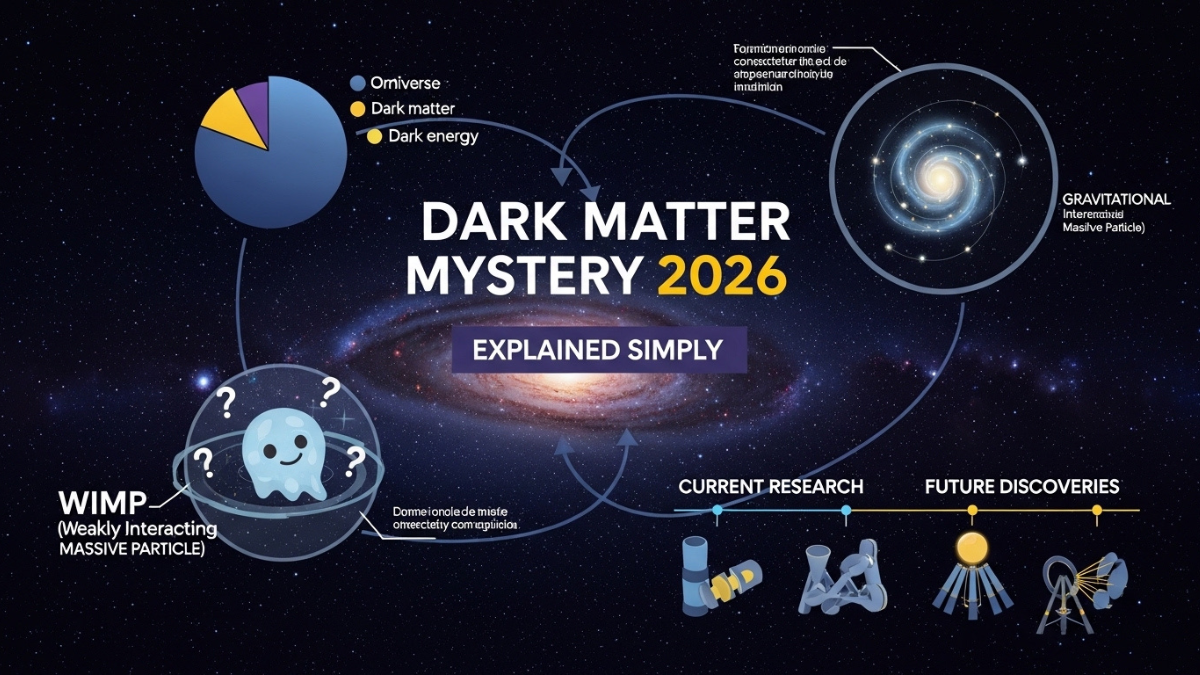
What Is Dark Matter?
Dark matter is a type of matter that does not emit, absorb, or reflect light, making it invisible to current instruments. However, its presence is inferred through its gravitational effects on visible matter.
Key characteristics include:
- Invisible and undetectable directly
- Does not interact with light
- Influences the motion of galaxies
- Makes up a large portion of the universe
These features make the dark matter mystery 2026 one of the most intriguing topics in space science. Scientists believe that dark matter forms the backbone of the universe mystery, holding galaxies together.
Evidence of Dark Matter
Although dark matter cannot be seen, there is strong evidence supporting its existence. Scientists rely on indirect observations to study it.
Here’s a table summarizing key evidence behind the dark matter mystery 2026:
| Evidence Type | Description | Importance |
|---|---|---|
| Galaxy Rotation Curves | Stars move faster than expected | Suggests unseen mass |
| Gravitational Lensing | Light bends around invisible mass | Confirms presence of dark matter |
| Cosmic Microwave Background | Radiation patterns from early universe | Supports dark matter models |
| Galaxy Clusters | Mass exceeds visible matter | Indicates hidden matter |
This evidence plays a crucial role in advancing space science and understanding the broader universe mystery.
Why Dark Matter Is Important
The dark matter mystery 2026 is not just a theoretical concept—it is essential for explaining how the universe works. Without dark matter, many observed phenomena would not make sense.
Key roles of dark matter include:
- Holding galaxies together
- Influencing cosmic structure formation
- Affecting the expansion of the universe
- Providing insights into the early universe
These contributions highlight how important dark matter is in solving the universe mystery and advancing space science research.
Theories About Dark Matter
Scientists have proposed several theories to explain the dark matter mystery 2026, but none have been definitively proven.
Popular theories include:
- Weakly Interacting Massive Particles (WIMPs)
- Axions (hypothetical particles)
- Modified gravity theories
- Dark energy interactions
Each theory attempts to explain the role of dark matter in the universe mystery, contributing to ongoing research in space science.
Challenges in Solving the Mystery
One of the biggest difficulties in understanding the dark matter mystery 2026 is the inability to directly detect it. This makes research complex and challenging.
Major challenges include:
- Lack of direct observation methods
- Limited technology for detection
- Complexity of cosmic measurements
- Conflicting theoretical models
These challenges slow down progress in space science, making the universe mystery even more intriguing.
Recent Discoveries in 2026
Recent advancements in space science have brought new insights into the dark matter mystery 2026. Improved telescopes and experiments are helping scientists gather more data.
Recent developments include:
- Advanced space telescopes detecting gravitational effects
- Improved particle detection experiments
- More accurate simulations of galaxy formation
These discoveries are gradually uncovering parts of the universe mystery, though much remains unknown.
Future of Dark Matter Research
The future of solving the dark matter mystery 2026 looks promising with ongoing advancements in technology and research.
Future possibilities include:
- More powerful telescopes and detectors
- International collaboration in space research
- New theories and models
- Potential direct detection of dark matter particles
These developments will play a key role in advancing space science and unlocking the secrets of the universe mystery.
Conclusion
In conclusion, the dark matter mystery 2026 remains one of the most fascinating and complex challenges in modern science. Despite significant progress in space science, much of the universe mystery is still unexplained. Dark matter continues to shape our understanding of the cosmos, influencing galaxies and cosmic structures. As research continues, scientists hope to uncover more answers, bringing us closer to understanding the true nature of the universe.
FAQs
What is the dark matter mystery 2026?
The dark matter mystery 2026 refers to the ongoing scientific effort to understand invisible matter in the universe.
Why is dark matter important in space science?
Dark matter is essential for explaining galaxy formation and the structure of the universe in space science.
Can dark matter be seen?
No, it cannot be directly observed, which makes it a major universe mystery.
What are the main theories about dark matter?
Theories include WIMPs, axions, and modified gravity models related to the dark matter mystery 2026.
Will scientists solve the universe mystery soon?
While progress is being made, the universe mystery of dark matter is still far from being fully solved.
Click here to learn more.