Airline route planning has become increasingly complex as climate-driven disruptions reshape the aviation landscape. What was once a process dominated by fuel efficiency, airspace availability, and scheduling has evolved into a dynamic exercise in risk management. With more frequent storms, heatwaves, turbulence events, and shifting wind patterns, airline route planning must now account for environmental uncertainty on a global scale. These changes are not occasional anomalies but persistent operational challenges tied closely to the changing climate.
As airlines strive to maintain safety, punctuality, and cost control, airline route planning is being reengineered around resilience. The growing influence of extreme weather means routes that were once reliable may now pose higher operational uncertainty. This reality has forced airlines to rethink how they assess aviation risk, allocate resources, and communicate disruptions to passengers.
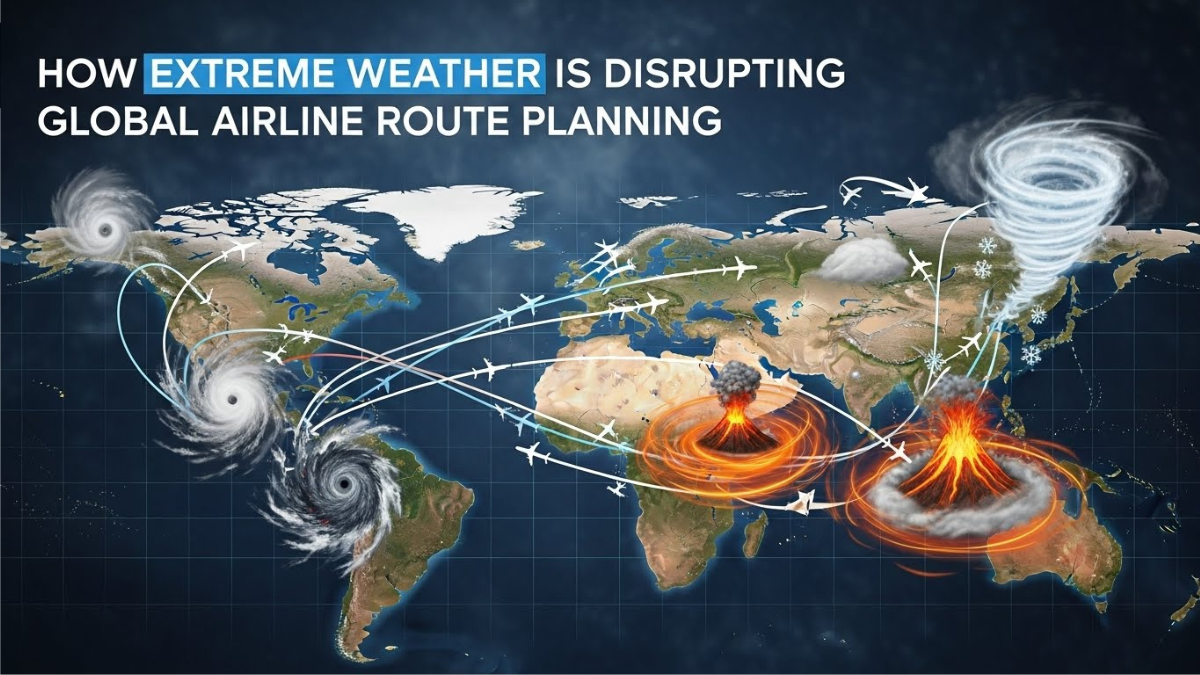
Rising extreme weather events and their operational impact
The increase in extreme weather events is one of the most disruptive forces affecting airline route planning today. Severe thunderstorms, hurricanes, snowstorms, and heatwaves now occur with greater frequency and intensity, often disrupting flight paths across continents. These conditions can close airspace, reduce airport capacity, and force last-minute rerouting, all of which complicate airline route planning decisions.
Heatwaves linked to climate change also affect aircraft performance, particularly during takeoff. High temperatures reduce air density, requiring longer runways and limiting payload capacity. Airline route planning must factor in these constraints, especially for airports in hotter regions. As extreme weather becomes more unpredictable, airlines face increased aviation risk related to safety, fuel burn, and schedule reliability.
Climate driven turbulence and aviation risk management
Another growing concern in airline route planning is clear-air turbulence, which is strongly associated with changes in the climate. Unlike storm-related turbulence, clear-air turbulence is difficult to detect using traditional radar systems. This poses significant aviation risk, as unexpected turbulence can cause injuries to passengers and crew while increasing aircraft wear.
To mitigate this aviation risk, airline route planning increasingly relies on advanced atmospheric modeling. These systems analyze wind shear, jet stream shifts, and temperature gradients to anticipate turbulence-prone regions. By adjusting altitudes and routes proactively, airlines can reduce exposure to turbulence linked to extreme weather, though such adjustments often increase flight time and fuel consumption.
Technology and data reshaping airline route planning
Modern airline route planning depends heavily on data analytics and real-time monitoring to respond to extreme weather threats. Airlines now integrate satellite data, meteorological forecasts, and predictive analytics to assess aviation risk continuously. These tools allow planners to simulate multiple routing scenarios and select the safest and most efficient option under changing climate conditions.
Artificial intelligence also plays a growing role in airline route planning. Machine learning models analyze historical disruption patterns to predict future risks associated with extreme weather. By learning from past events, airlines can anticipate which routes are most vulnerable and proactively adjust schedules. This data-driven approach helps balance operational efficiency with safety amid rising aviation risk.
Key factors influencing airline route planning today include:
- Increased frequency of extreme weather events
- Climate-related turbulence risks
- Heat-related aircraft performance limits
- Real-time weather data integration
- Predictive analytics for aviation risk mitigation
The table below illustrates how airline route planning priorities have shifted in response to climate challenges:
| Factor | Traditional Focus | Modern Airline Route Planning |
|---|---|---|
| Weather consideration | Secondary | Central decision driver |
| Turbulence management | Reactive | Predictive and proactive |
| Climate impact | Minimal | Core planning variable |
| Aviation risk assessment | Static models | Dynamic real-time analysis |
| Route flexibility | Limited | High adaptability |
Cost, emissions, and sustainability trade-offs
Adapting airline route planning to extreme weather conditions comes with financial and environmental trade-offs. Rerouting flights to avoid storms or turbulence often increases fuel burn, raising operational costs and emissions. This creates tension between safety-driven airline route planning and sustainability goals linked to climate commitments.
However, airlines are exploring strategies to minimize these trade-offs. Optimized routing algorithms aim to reduce unnecessary detours while still managing aviation risk effectively. Some carriers are also investing in sustainable aviation fuels and more efficient aircraft to offset the emissions impact of longer routes. As climate pressures intensify, airline route planning must balance safety, cost, and environmental responsibility.
Long term adaptation and future outlook
Looking ahead, airline route planning will increasingly be shaped by long-term climate adaptation strategies. Airlines are collaborating with meteorological agencies, regulators, and technology providers to improve forecasting accuracy and standardize aviation risk assessment methods. These partnerships are essential for building resilience against extreme weather disruptions.
In conclusion, airline route planning is undergoing a fundamental transformation driven by rising extreme weather events and evolving climate realities. By integrating advanced data systems, predictive analytics, and adaptive strategies, airlines can better manage aviation risk while maintaining operational stability. As weather volatility becomes the norm rather than the exception, airline route planning will remain a critical lever for ensuring safe, reliable, and sustainable global air travel.
FAQs
Why is airline route planning affected by extreme weather?
Extreme weather disrupts airspace, airport operations, and aircraft performance, forcing constant adjustments in airline route planning.
How does climate change increase aviation risk?
Changes in the climate lead to more turbulence, heat stress, and unpredictable storms, all of which elevate aviation risk.
What tools are used in modern airline route planning?
Airlines use satellite data, predictive analytics, and AI-driven models to manage aviation risk and respond to extreme weather.
Does avoiding extreme weather increase flight costs?
Yes, rerouting to avoid extreme weather often increases fuel consumption and operational costs.
Will airline route planning continue to change in the future?
Yes, as climate impacts intensify, airline route planning will continue evolving to prioritize safety, resilience, and sustainability.
Click here to learn more.