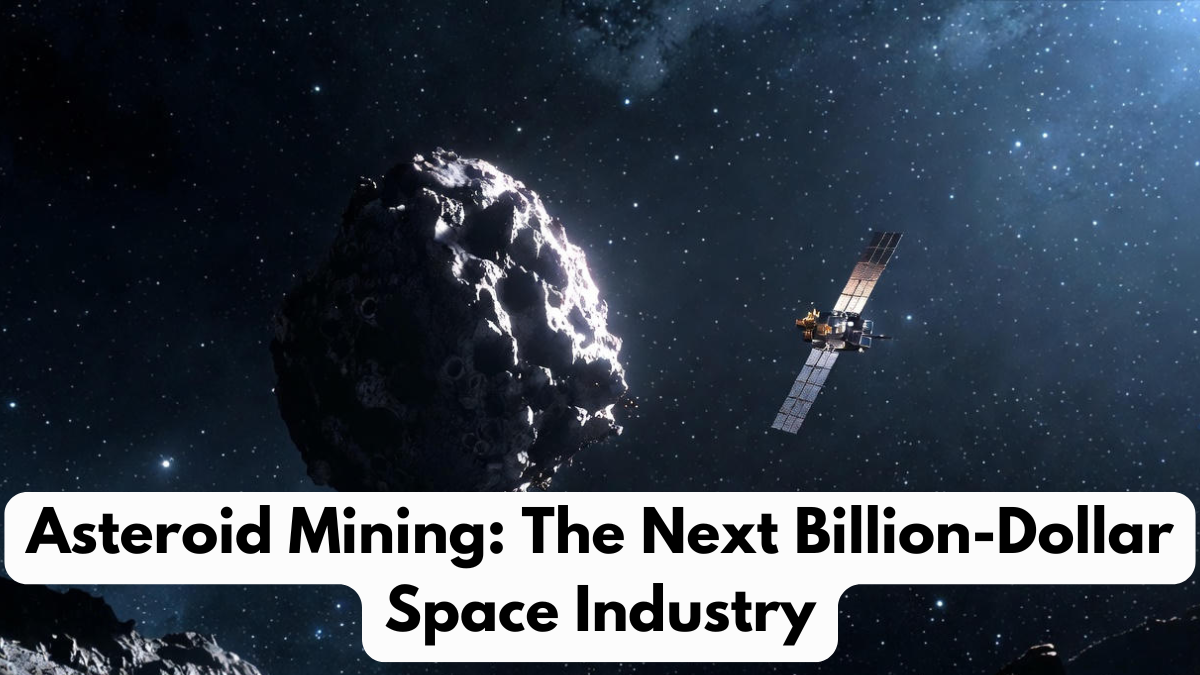
The dream of harvesting resources from space is quickly transitioning from science fiction to reality through asteroid mining. As the global demand for rare metals, minerals, and sustainable resources continues to rise, scientists and entrepreneurs are looking to asteroids as the next frontier of the space economy. These celestial bodies contain abundant quantities of valuable elements such as platinum, gold, nickel, and even water—materials that could revolutionize industries both on Earth and in outer space.
By 2030, experts predict that asteroid mining will become one of the most profitable ventures in the growing space economy. The ability to extract and process materials from asteroids will reduce our dependence on Earth’s dwindling natural resources while fueling the expansion of human civilization beyond our planet. Companies and space agencies around the world are already investing billions in technologies that could make mining in space a commercial reality.
The Science Behind Asteroid Mining
The foundation of asteroid mining lies in identifying, reaching, and extracting valuable resources from near-Earth objects (NEOs). Asteroids are remnants of the early solar system and contain raw materials formed billions of years ago. Many of these bodies are rich in metals and water ice, making them perfect targets for mining and resource extraction in the space economy.
There are three primary types of asteroids that hold potential for mining:
- C-type (Carbonaceous): Contain water and organic compounds useful for fuel production.
- S-type (Silicaceous): Rich in nickel, iron, and magnesium.
- M-type (Metallic): Contain high concentrations of precious metals such as platinum and gold.
The process of asteroid mining involves robotic spacecraft identifying suitable targets, landing on their surfaces, and using drills, lasers, or autonomous machinery to extract materials. These resources can then be refined in space or transported back to Earth for use in manufacturing and technology. AI and robotics play crucial roles in ensuring precision and safety during these complex operations, making the integration of automation essential for success in the space economy.
Comparison Between Earth Mining and Asteroid Mining
To understand the transformative impact of asteroid mining, it’s important to compare it with traditional terrestrial mining practices.
| Feature | Earth Mining | Asteroid Mining |
|---|---|---|
| Environmental Impact | High pollution and ecosystem damage | Minimal impact on Earth’s environment |
| Resource Availability | Limited and depleting | Virtually unlimited supply in space |
| Cost Efficiency | High due to labor and logistics | High initial cost but lower long-term expense |
| Accessibility | Restricted by geography and depth | Accessible through robotic spacecraft |
| Sustainability | Finite and environmentally harmful | Infinite and renewable in the space economy |
This comparison highlights how asteroid mining not only addresses the scarcity of resources on Earth but also supports sustainable growth in the space economy.
The Role of Asteroid Mining in the Global Space Economy
The integration of asteroid mining into the space economy has far-reaching implications. The materials obtained from asteroids could power satellites, build space habitats, and supply fuel for deep-space missions. For example, water extracted from asteroids can be split into hydrogen and oxygen, creating rocket fuel directly in space. This could dramatically reduce launch costs and enable long-term exploration of the Moon, Mars, and beyond.
Moreover, the economic potential of asteroid mining is staggering. A single M-type asteroid could contain trillions of dollars’ worth of metals. This not only opens new investment opportunities but also diversifies the global economy. Governments and private companies are already collaborating to establish frameworks for resource ownership, environmental regulation, and trade within the space economy.
The development of this new industry will also create high-tech jobs in robotics, artificial intelligence, aerospace engineering, and data analytics, fostering innovation across multiple sectors. The ripple effects of asteroid mining will reach far beyond the stars, influencing manufacturing, energy, and sustainability efforts back on Earth.
Technological Challenges and Future Prospects
Despite its enormous promise, asteroid mining faces several technological and logistical challenges. The primary obstacles include identifying viable asteroids, developing reliable extraction technology, and managing transportation of mined materials. However, advancements in AI, robotics, and spacecraft engineering are rapidly closing these gaps.
The collaboration between private companies like SpaceX, Blue Origin, and emerging space economy startups is accelerating research into autonomous mining equipment and in-orbit refining systems. Furthermore, international agencies like NASA and ESA are conducting missions to test resource extraction from near-Earth asteroids, paving the way for commercial exploitation.
By 2040, experts believe that asteroid mining could become a trillion-dollar industry, fueling both Earth-based and extraterrestrial economies. The long-term goal is to create self-sustaining colonies that use space resources to build infrastructure and support human life beyond Earth—a fundamental step toward becoming an interplanetary civilization.
Conclusion
Asteroid mining represents humanity’s next giant leap in innovation, sustainability, and exploration. By harnessing the vast resources of space, we can solve the challenges of resource depletion on Earth and accelerate the growth of the space economy. The combination of robotics, AI, and advanced engineering is turning this once-unimaginable idea into a practical and profitable industry. As space becomes the new frontier of economic expansion, asteroid mining will not only fuel rockets but also power the global shift toward a cleaner, more sustainable future.
FAQ
What is asteroid mining?
Asteroid mining is the process of extracting valuable materials such as metals, minerals, and water from asteroids to support industries on Earth and within the space economy.
How does asteroid mining benefit the space economy?
By providing resources for spacecraft fuel, construction, and manufacturing, asteroid mining reduces costs and boosts sustainability within the space economy.
What materials can be obtained from asteroids?
Asteroids contain metals like gold, platinum, and nickel, as well as water and other compounds essential for fueling and sustaining life in space.
What are the challenges of asteroid mining?
Major challenges include the high cost of space missions, developing autonomous mining robots, and transporting extracted materials efficiently.
When will asteroid mining become commercially viable?
Experts predict that commercial asteroid mining will become feasible within the next two decades, as technological advancements and investments in the space economy continue to grow.
Click here to learn more